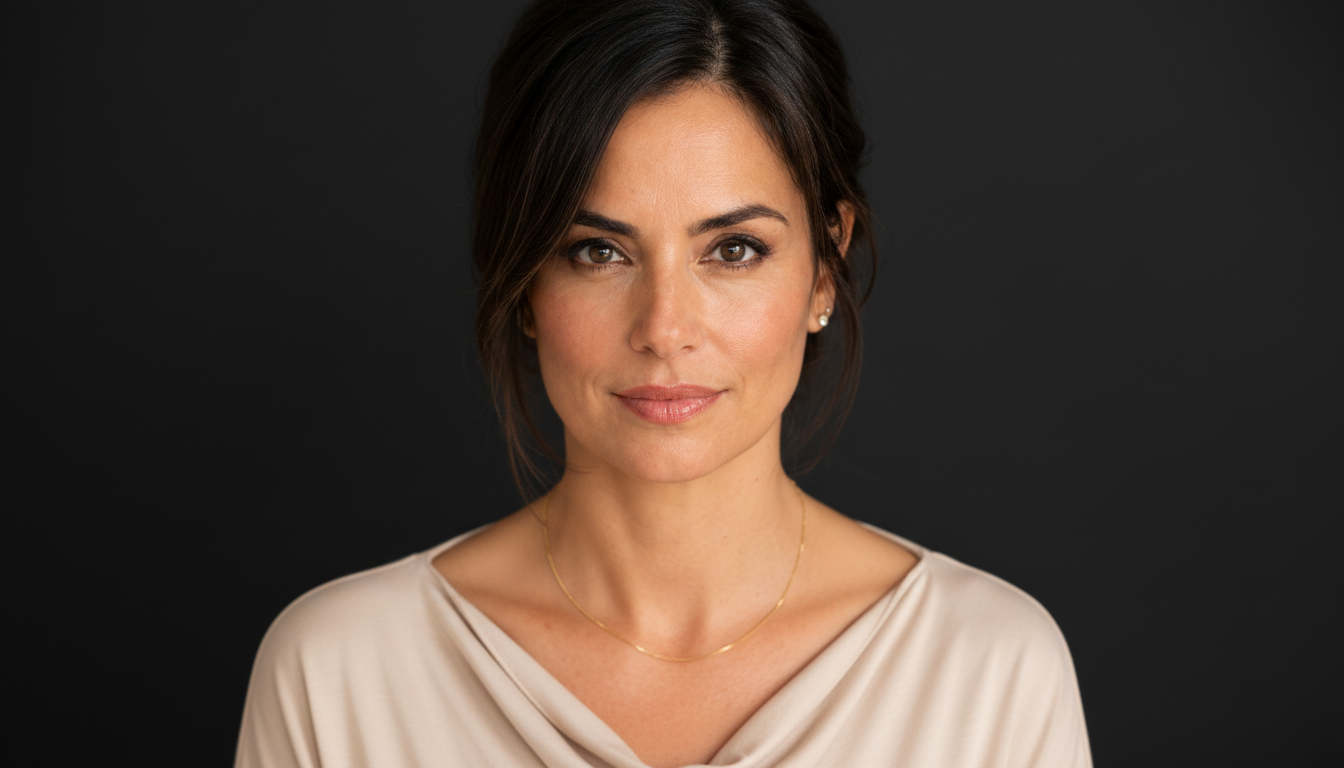
She spent 15 years watching.
Then she decided to tell.
The unwritten standards. The invisible habits. The things passed down quietly in certain rooms that no one was teaching publicly. Isabelle Vargas collected them for fifteen years — and then built MADRE so no woman would have to figure them out alone.
She grew up watching two people
who understood something most
people never figure out.
Isabelle Vargas grew up in a household that straddled two worlds. Her mother, Claudine, came from Lyon, France — the daughter of a seamstress who believed that how you presented yourself to the world was a form of self-respect, not vanity. Her father, Marco, was a second-generation Italian-American from New York — a restaurateur who set his table properly every single night, even when it was just family, even when money was tight.
He used to say: “The table is where people decide who you are.”
She grew up watching both of them. She grew up learning, without being formally taught, that a certain quality of life — intentional, self-respecting, quietly refined — was not the exclusive territory of the wealthy. It was the territory of the deliberate.
“My mother ironed her clothes the night before because she said the morning belongs to your mind, not your wardrobe. My father never sat down to eat without a properly laid table. Neither of them was wealthy. Both of them were undeniable.”
At Columbia, she studied Art History — fell in love with the visual language of objects, spaces, and how people signal who they are through what they surround themselves with. After graduation, she spent fifteen years inside America’s luxury fashion industry, working as a buyer and later a consultant for brands that sold to the wealthiest women in the country.
She travelled constantly. She sat in boardrooms in Manhattan and dining rooms in Paris. She watched how women with real generational wealth carried themselves — and she watched how women with new money tried, and often failed, to replicate it. The difference was never what they owned. It was what they had internalised.
She was always in the room.
She was always taking notes.
Across fifteen years of working with the wealthiest women in America — inside their wardrobes, their shopping rituals, their professional environments, their social worlds — Isabelle kept noticing the same thing. The women who were consistently received as exceptional were not the most beautiful. They were not always the most accomplished. They were not always the best dressed.
They were the ones who had done a specific kind of internal work that produced a specific kind of external effect. An effect that rooms responded to before those women had said a word. A quality that other women recognised instantly and could rarely name.
She started calling it undeniable. And she started writing down everything she observed that produced it.
The most consistently received women dressed with intention, not expense. They had decided what their visual standard was and they held it — privately, daily, regardless of the audience. The wardrobe was the expression of a decision already made inside.
Presence — the quality that made rooms shift when certain women entered — was not a personality trait. It was the accumulated result of private discipline held consistently over time. The women who had it had practised it. Usually for years before anyone noticed.
The habits were learnable. The rituals were specific. The standards were articulable. What looked like effortless refinement was, almost without exception, a set of daily practices — most of them unglamorous, none of them expensive — held privately without audience.
In her late thirties, her life changed.
She rebuilt herself from the inside out.
In her late thirties, Isabelle’s marriage ended. She processed it the way she processes most things — with discipline, with journaling, and with the quiet decision to rebuild herself deliberately rather than reactively.
It was during that period that she began writing down everything she had observed over fifteen years. The habits. The rituals. The unspoken standards. The invisible shifts that separated the women who aged into power from the ones who aged out of visibility. Pages and pages of it — not tips, not advice, but a curriculum. A specific, sequenced system for becoming the woman she had spent fifteen years watching.
A friend read them one evening and said: “Isabelle. This needs to exist in the world.”
“I didn’t build MADRE to teach women how to look rich. I built it because I spent fifteen years in rooms where the difference between women who were quietly exceptional and women who were merely capable was never their résumé — it was everything they had built inside themselves. And I needed to tell someone.”
MADRE was born from those pages. The channel. The checklist. The Complete System. All of it is the curriculum she assembled over fifteen years of watching — and rebuilt herself with in her late thirties.
She created the channel deliberately in a voice-led, content-first format — not to hide, but because she believed the message should always be bigger than the messenger. What matters is not who Isabelle is. It is what she has observed, what she has learned, and what she has decided to give freely to every woman who is ready to receive it.
— Isabelle Vargas
Not a channel about elegance.
A transformation channel.
MADRE is the channel that gives women the internal curriculum — the specific, daily, unglamorous habits of thought, appearance, behaviour, and standard — that produces a woman so grounded in who she is that the external results become unavoidable.
The woman we are building toward is not performing anything. She is not trying to impress anyone. She has done the internal work so thoroughly and so consistently that her whole life — how she dresses, how she speaks, how she moves, how people treat her — has quietly rearranged itself around who she has become.
“Thank you for making me become a better version of myself. I now dress in a way that feels right to me and people notice it. My words carry influence when I speak and people receive my opinion. I am a woman I am proud of — and that shows in how I am treated. I am not passed up anymore.”
The system is built.
The question is whether you are ready to use it.
I have been watching this channel for three months. I changed how I enter rooms. I changed how I speak in meetings. I changed my morning — completely. I am 54 years old and I feel more like myself than I have in twenty years. Whatever Isabelle is sharing — it works. Not because it is magic. Because it is true.
— A MADRE Viewer
Start with the free checklist. It is twelve rituals — the complete morning architecture of the undeniable woman. It costs nothing. It takes one morning to read. And it will change how you begin every day from the moment you implement it.